
Buying Guide
PE Case vs. Plywood Flight Case: Which Should You Buy?
If you are equipping a rental fleet or quoting a tour, the choice between a molded PE case and a traditional plywood road case decides your repair bill for the next five years. Here is the comparison we give our own customers — including where plywood still wins.
Both cases do the same job on paper: move a rack, a lighting fixture or a video wall from the warehouse to the venue without damage. The difference shows up in year three — after two hundred load-ins, two rainy festivals and one forklift mistake.
A molded PE case is a single hollow shell formed from polyethylene. A plywood road case is a build: birch panels, aluminium extrusion, steel ball corners, rivets, foam. One is a moulded product; the other is closer to furniture. That difference — not brand loyalty — is what decides which case is still in service when the other one has been written off.
For a fleet that moves weekly, a molded PE case usually wins on cost per year of service. For one-off custom sizes, drawer interiors, or a tender that explicitly specifies a plywood road case, plywood is still the correct answer. Everything below is the reasoning, so you can check it against your own numbers.
How each case is actually built
The molded PE case
Polyethylene is heated and formed against a mould — rotational moulding for most trunk and rack shells, with blow moulding used for some bodies — so the finished case is one continuous skin with integral ribs, corner radii and handle recesses. There is no seam along the lid edge, no metal corner to pull loose and no joint for water to travel along. Latches, hinges and handles bolt through moulded bosses that are part of the shell itself.
The structure is a monocoque: the skin carries the load. That is why a PE case can be both light and hard-wearing — under impact it flexes, then returns to shape, instead of deforming permanently.
The plywood road case
A road case is assembled from parts: panels cut to size, edged in aluminium extrusion, joined with steel ball corners and rivets, lined with foam or carpet, then finished in laminate or tolex. It is a mature, well-understood way to build a case, and a good builder can make it beautiful.
Building panel by panel buys dimensional freedom — any size, any interior, one piece at a time. It also multiplies the number of parts. Every rivet is a potential loosening point; every panel edge is a potential path for water.
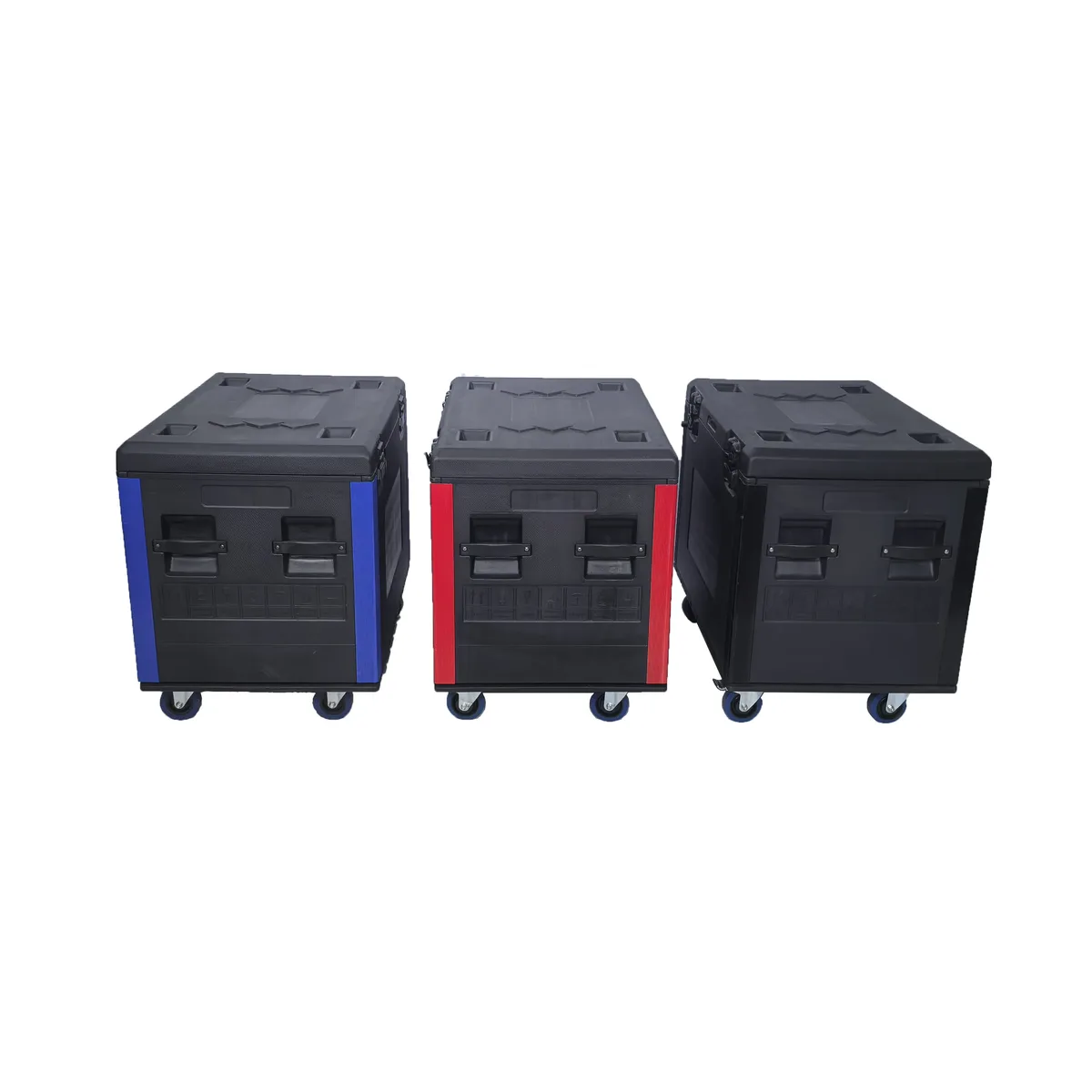
Side-by-side comparison
This is the table we would want if we were the buyer. Where plywood is the better answer, it says so.
| Criterion | Molded PE case | Plywood road case |
|---|---|---|
| Water and humidity | No panel edge to absorb water. The only weak points are the lid gasket and latch seals. | Sealed edges shed rain well. But once water enters a damaged edge, the plywood core swells and that panel is finished. |
| Impact resistance | Flexes and recovers. Deep gouges are usually cosmetic; punctures are rare. | Ball corners absorb hits well. A hard enough blow crushes the panel locally and can split the extrusion. |
| Field repair | Cracks are welded by a plastics shop. Not a truck-stop repair. | A wrecked panel can be cut out and re-riveted with hand tools. Plywood's biggest practical advantage. |
| Weight | Lighter for the same cavity — one skin instead of plywood plus extrusion plus steel corners. | Heavier per cavity; the gap usually widens as cases get larger. |
| Shape retention | Moulded geometry keeps stack surfaces flat after years of truck packs. | Holds up if the frame is well built; edges and extrusions deform under heavy abuse. |
| Interior precision | CNC-cut foam in a repeatable cavity — identical from unit to unit, fast to produce. | Built to exact internal dimensions, which suits unusual cavities and drawer systems better. |
| Custom size at low volume | Existing moulds cover most sizes. A non-standard size means new tooling and a project schedule. | Any size, one unit at a time, with no tooling cost. |
| Branding and finish | Colour through the material, moulded-in logo, screen printing. Fewer surface options. | Laminate, tolex, stencils, engraved plates — the wider palette. |
| Unit cost | Competitive at fleet volume. A one-off non-standard size carries tooling. | Attractive for a single custom unit; labour-heavy across a large fleet. |
| Lead time | 15 days for standard models from existing moulds. | Depends on the builder's queue. No tooling, but panel work is hand work. |
Where a molded PE case wins
Water, mud and outdoor work
Festival season is a water test. A single-skin shell has nowhere for moisture to collect and no core to rot, so a case that spent Saturday night in a field can be dried with a cloth rather than dried out over a week. For rental companies working outdoor events, this alone often settles the decision.
Impact you do not control
Cases are damaged by people who do not own them: venue crews, freight handlers, sub-contracted drivers. A PE shell that flexes absorbs that abuse without permanent deformation, and it does not develop the loose rivets and split extrusions that turn a plywood case into a rattle. You still get scars — you just do not get structural failure.
Fleet consistency and spares
Moulded cases come out of the same mould to the same dimensions. Case 14 and case 15 of a hundred-unit order stack together, fit the same truck pack and take the same foam insert. When you replace one three years later, it still matches. Anyone who has tried to match a hand-built case to an older batch knows why this matters.
Warehouse labour
Plywood cases need periodic care: tightening hardware, replacing rivets, touching up laminate, re-gluing foam. None of it is expensive per case; all of it is a line in your operations budget and a person's afternoon. A PE shell needs its latches and gaskets checked and nothing else.
Where plywood still wins
Tenders and specs that name a plywood case
Some broadcast, government and defence procurement documents specify a plywood road case, or an ATA-style construction, in language that leaves no room for substitution. If the document says it, buy it. No material argument wins against a written spec, and trying to substitute will cost you the order.
One-off sizes and unusual cavities
If you need a case for a 2.7 m truss segment, or a mixed load of frames, cables and a console, a builder can cut and fit to the millimetre next week. A moulded case can only be as good as the mould it comes from.
Interiors with drawers, shelves or mixed gear
Drawer stacks, pull-out shelves, compartment dividers and hinged worktops are all panel work. They can be built into a PE case, but they are native to plywood, and the plywood version will usually be cheaper and quicker to deliver.
Finish as part of the brand
Corporate AV, hospitality and studio clients sometimes want a case that looks like part of the furniture — a laminate face, a branded plate, a colour that matches an installation. Plywood gives a wider surface palette. Moulded PE gives you durable colour through the material, which is a different look, not a lesser one.
We manufacture molded PE cases. If you need twelve cases in three weeks and one of them has a custom drawer stack, plywood will be faster and probably cheaper — we will tell you so rather than sell you the wrong case.
The failure modes you will actually see
Anyone can list advantages. Here is what goes wrong in the field, because it is a better guide to ownership cost than any specification sheet.
On a molded PE case
- Latches and hinges are the wear parts. They take the abuse that the shell survives, and after several years of daily use they are what you replace.
- Gasket ageing. A compressed or hardened lid gasket stops sealing long before the shell shows any problem. It is cheap to replace and easy to forget.
- UV on light colours. Polyethylene chalks and fades in strong sun. Black hides it; white shows it. This is cosmetic, but rental clients notice.
- Over-torqued hardware. Bolting through a moulded boss and overtightening can crack the boss. Fitted at the factory, this does not happen; refitted badly in a workshop, it can.
- Heat in closed containers. Polyethylene softens as temperature climbs, and a dark case left in a steel container in direct summer sun gets very hot. On desert or Middle East tours, specify a lighter colour and ventilate the container.
- Concentrated point loads. A heavy fixture mounted on a small footprint without an internal frame puts stress exactly where the shell is weakest. Tell your supplier the weight and how it is mounted.
On a plywood road case
- Water ingress at a damaged edge — the failure that ends most plywood cases. The core swells, the laminate lifts, the panel is scrap.
- Delamination after repeated wet-dry cycles, especially where extrusion and panel meet.
- Rivets loosening and pulling through thin panels, which turns a rigid box into a rattling one.
- Ball corners pulling through on heavy drops, since the corner load transfers into a small area of panel.
- Foam compression — the interior slowly stops holding what it was cut for, and the case starts damaging the gear it was bought to protect.
- Weight creep as repairs add plate, rivets and reinforcement over the years.
The number that matters: cost per service year
Purchase price is the least useful number in this comparison, because it ignores everything that happens afterwards. Compare this instead:
Cost per service year = (purchase price + total repair cost + downtime cost) ÷ years in service
Downtime is the term buyers forget. A case out of service is not just a repair invoice — it is a fixture without transport, and possibly a rental you cannot fulfil. Price that in and the cheap case stops being cheap.
Ask both suppliers for the same five inputs, in writing:
- Unit price at your actual quantity, not at a sample quantity
- Weight, for the same internal dimensions
- Expected service life at your trips-per-year figure
- Which components are wear parts, and what replacements cost
- Lead time, and lead time for a repeat order three years from now
In daily rental use, the price premium of a molded PE case typically pays itself back within three to five years. In occasional use — a church that moves gear twice a month, a school with one annual production — the cheaper plywood case usually wins outright, because neither case will ever wear out. That is the honest shape of the trade-off, and it is why the same manufacturer will recommend different cases to two different customers.
How to choose: six questions
- How many trips per year? Under about thirty, plywood is fine and cheaper. Over a hundred, the maintenance difference starts to dominate.
- Who handles the cases? Your own crew only? Plywood survives. Third-party freight, airlines and venue crews? PE absorbs the abuse better.
- Is there a single heavy item with a small footprint? Then the load path matters more than the material — ask for an internal frame, in either material.
- Does the tender name a construction? Read the specification before you read any brochure.
- Where will repairs happen? On site with hand tools, plywood. In your workshop with time to plan, PE.
- Is the interior standard or bespoke? Standard foam cavities suit PE. Drawers, shelves and mixed loads suit a built plywood interior.
| If this is you | Choose |
|---|---|
| Touring or rental fleet, moving weekly, outdoor events | Molded PE — lower maintenance, water-resistant, consistent spares |
| Fixed installation with an annual move | Either; plywood is usually cheaper for the same protection |
| LED panel or lighting trunk packs, standard sizes | Molded PE trunk with integral dividers |
| One-off size, drawers, or a mixed-gear workbox | Built plywood case |
| Export shipping with a documented spec | Read the spec first, then decide — and tell your supplier what it says |
FAQ
Are molded PE cases strong enough for touring?
Yes, for road, van and most air freight. The shell is a monocoque: it flexes under impact and returns to shape instead of deforming permanently. The limits are concentrated point loads — such as a heavy fixture bolted to a single spot of the base without an internal frame — and heat in closed containers. Tell your supplier the fixture weight and mounting method and let them review the load path.
Can a PE flight case be repaired if the shell cracks?
A cracked polyethylene shell can be repaired by hot-air or extrusion plastic welding, which any plastics fabricator can carry out. What you cannot do is cut out the damage and re-rivet a new panel, the way you repair a plywood case with hand tools on site. This is the honest trade-off: PE shells fail less often, but when they do fail the repair is less convenient.
Does a molded PE case meet ATA 300?
ATA 300 is a specification for reusable shipping containers, and molded PE cases are widely used in air freight. Whether your tender's ATA 300 wording is satisfied depends on the exact category and the test documentation it asks for, not on the material alone. If a customer or a tender names ATA 300 Category I, raise it with your supplier before you quote, so any required paperwork is confirmed in writing.
Which is better for transporting LED panels, PE or plywood?
Both work, and the decision comes down to panel size and pack count. Molded PE trunk cases with integral dividers are a common choice for packs of six to ten panels because the load is uniform and the case is lighter per panel. For very large panels, or mixes of panels, frames and processors in one case, a built plywood trunk with a custom divider set gives more freedom in the interior layout.
How much lighter is a PE case than a plywood case?
It is lighter for the same internal cavity, because the structure is a single molded skin rather than plywood panels plus aluminium extrusion plus steel corners. Do not accept a percentage figure from any supplier without seeing both cases weighed at the same internal size, because the gap narrows or widens depending on wall thickness and how much steel the plywood build uses.
Next step
If you have read this far and you are still unsure, the fastest way to settle it is to send us your case list: what goes in, how often it moves, and where it ships. We will tell you which of our moulded models fits, and where a plywood build would serve you better — request a quote or an honest answer.
Not Sure Which Case Fits Your Fleet?
Send your case list — what goes in, how often it moves, where it ships. We will recommend the right construction, even when it is not ours to make.
Talk to Us